

Promoting Ethical Profits and Responsible Commerce

NEW UPDATED WEBSITE COMING SOON!


Breaking News!

White Paper on Payday and Direct Deposit Loans...

Home
.................................
About Us
.................................
Publications

.................................
Legislative Updates

.................................
Get Involved

.................................
What's New

.................................
Contact Us

................................
Site Map
................................
.

Initiatives:

Gulf Coast Alternative Staffing Initiative

Day Labor

Mortgage Lending

Payday Lending


Don’t Borrow Trouble® is an unbiased, Freddie Mac and community-sponsored, non-profit agency that knows the programs, products and people throughout Tucson. These resources can help you understand your financial decisions when it comes to homeownership and payday lending practices.

Hotline (520)792-3087

Our Mission

The Center for Economic Integrity engages in research, education and advocacy to strengthen local economies by mobilizing and protecting marginalized people, holding corporations and industries accountable to communities and cultivating support for good business practices.


New Legislation to Focus on Online and Bank Payday Lending

Subject: CFA NEWS: CFA Applauds New Legislation Focusing on Online and Bank Based Payday Loans

FOR IMMEDIATE RELEASE                               Contact: Tom Feltner, CFA (202) 618-0310
January 30, 2013                                                                                                                              

NEW LEGISLATION FOCUSES ON ONLINE AND BANK-BASED PAYDAY LOANS, SEEKS TO CLOSE LOOPHOLES AND PROTECT CONSUMERS' BANK ACCOUNTS

Senators Merkley, Blumenthal, Durbin and Udall Move to Protect Consumers from High-Cost Credit that Evades State Law 

Washington, DC - The Consumer Federation of America applauds Senator Jeff Merkley (OR), Richard Blumenthal (CT), Dick Durbin (IL) and Tom Udall (NM) for the introduction of the Stopping Abuse and Fraud in Electronic (SAFE) Lending Act.  The bill is a necessary response to online lenders affiliated with Native American Tribes and banks offering payday loans that have designed abusive products that evade state consumer protections.  

As state legislatures across the country continue to crack down on abusive practices, such as triple digit interest rates and unfair payment and debt collection practices, the SAFE Lending Act will ensure that consumers get the same protections regardless of whether they take out a loan from a storefront payday lender or a lender operating online.

"Lenders partnering with Native American Tribes and banks offering payday-like deposit advance loans are evading existing consumer protections and putting consumer's bank accounts at risk," said Tom Feltner, director of financial services at the Consumer Federation of America.  "Consumers should be able to make credit choices with the confidence that all lenders are playing by the same set of rules."

Currently, online lenders that partner with Native American Tribes are claiming immunity from enforcement of state laws that cap interest rates and provide other borrower protections.  Banks that offer deposit advance loans at high rates with short repayment terms are currently not subject to state consumer protections. 

The SAFE Lending Act would ensure that all lenders are playing by the same rules by:

* Requiring all online small-dollar lenders (such as payday lenders) to comply with state law if it provides better consumer protections than federal law;

* Preventing banks from making payday loans in violation of the state law where the consumer resides;

* Providing new federal enforcement measures to protect consumers from online payday lenders that seek to evade state consumer protection laws, such as by locating their businesses off-shore, or affiliating with a Native American Tribe and claiming the right to assert the tribe's sovereign immunity; and

* Empowering Native American Tribes to enlist the help of the CFPB where needed to protect their members from abusive payday lending on the reservation, and respecting tribal laws that provide stronger consumer protections than are available under state law.

The SAFE Lending Act would also protect consumers' bank accounts by:

* Closing the single payment loophole in the Electronic Fund Transfer Act and ensure that consumers have control over how lenders access their bank accounts for payment and collections of high-cost loans;

* Safeguarding consumers' personal information by banning "lead generators" who collect information like Social Security numbers, income and bank account information; and

* Prohibiting lenders from using a borrower's bank account numbers to create unsigned checks used to withdraw funds, even when consumers have opted out of making payments electronically.

"Electronic payments should be a convenience for the consumer, not a collection method for the lender," said Feltner. "This proposal would make sure that unfettered access to a consumer's bank account is not a substitute for fully underwriting a loan."

The Consumer Federation of America is a non-profit association of more than 250 consumer groups that was established in 1968 to advance the consumer interest through research, advocacy, and education.

Payday Loans
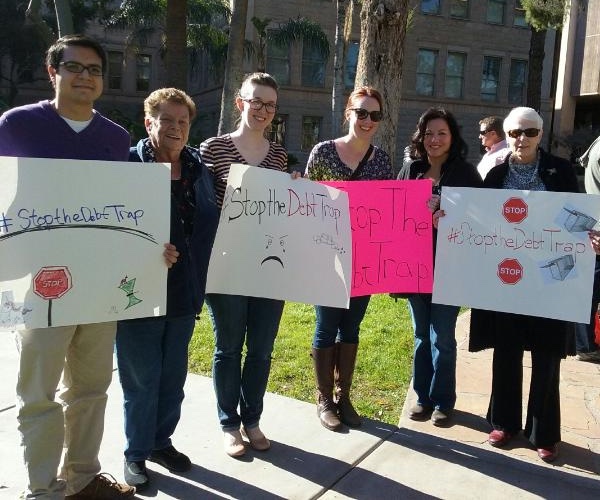
Fast Cash or Debt Trap?

Pay Day Loans are small cash advances secured by a personal check held for future deposit or electronic withdrawal from a customer’s bank account. These loans of $50-$500 are due in full on the borrower’s next pay day or within 14 days. If the customer is unable to repay the loan within two weeks, most companies allow for the loan to be extended, or rolled over, by paying the interest on the loan. Customers are charged fees between $15 and $17.65 per $100 borrowed. The APR rate on pay day loans typically falls within a range of 390% to 500%.

As of July 1st, 2010 Payday Lending in Arizona is no longer a state sanctioned, legal activity. All small loans lenders in AZ must follow the small loan act limiting interest rates to 36% APR or less.

See MapsSome of the heaviest concentrations of payday loan businesses are located within a three mile radius of Davis Monthan AFB. Studies indicate that nation wide there is “irrefutable geographic evidence demonstrating that payday lenders aggressively target members of the military & their families.” SCEI's research indicates that the number of payday loan shops near DM Air Force Base has nearly doubled, from 25 in the year 2003 to 46 now.

Payday loan locations are concentrated in high/medium stress & high poverty areas in Tucson & Pima County. This pattern raises questions regarding industry targeting of disadvantaged consumers.


GULF COAST ALERNATIVE STAFFING INITIATIVE

The Center for Economic Integrity (SCEI) has been sub contracted by Public/Private Ventures to assess the feasibility of seeding up to three alternative staffing organizations (ASOs) in the Gulf Coast and provide technical assistance to selected nonprofits in the region interested in launching an ASO as a unique social enterprise. The goal of this initiative is to help displaced workers reattach to the labor market and connect workers that face multiple barriers to employment with jobs in the region.

The initiative will provide resources and technical assistance to local nonprofits, develop a network of ASOs, meet the employment and reconstruction demands within communities sustaining economic and physical destruction, reattach individuals to the labor market and serve as a conduit for labor market change.


Home : About Us : Publications : Legislative Updates : Get Involved : What's New : Worker's Corner : Contact Us : Site Map

© Copyright 2006 Southwest Center for Economic Integrity All Rights Reserved

P.O. Box 1865
Tucson, AZ 85702

Web Site Made Possible by the generous support of
The Wallace Foundation